Read the contract before you sign it. Otterdeck flags the risky bits in plain English.
Paste in the agreement a client sent you, and see where the risk sits — before you sign, not after.
A client sends over a contract. It's six pages of dense clauses, half of it in a font you have to squint at. You skim it, you don't really understand the middle bit, and the project starts Monday. So you sign.
Most freelancers and consultants have done exactly this. Not because they're careless — because the alternative is paying a lawyer a few hundred dollars to read a contract for a $12k job, and that math never works. So you sign and hope.
The trouble is that one buried clause can eat your whole margin. They own everything you make. Your liability is uncapped. They pay net-90, so you're funding their project for three months. You don't find out until it's already gone wrong.
Today we're releasing contract review — Otterdeck's AI reads the agreement a client sends you and shows you where the risk sits, in plain English. You can check a contract right now, free and with no sign-up.
One thing up front, and we mean it: this is a risk highlighter, not legal advice. Otterdeck isn't a law firm. It points at the clauses worth questioning so you know what to ask about — a lawyer makes the actual legal call. Think of it as a smart second read before you sign, not a substitute for one.
Why one clause can cost you the job
The contracts clients send you — an NDA (a non-disclosure agreement), an MSA (a master service agreement), a statement of work — are written by their side, for their side. That's not villainy. It's just whose lawyer drafted it.
So the defaults lean their way. The IP clause quietly assigns them everything, including tools you brought with you. The liability clause has no cap, so a mistake on a small job could expose you to a huge bill. The payment terms say net-90. An auto-renewal buried near the end locks you in for another year.
None of it is flagged. It reads as "standard." And when you don't have a lawyer on retainer, "standard" is whatever they sent.
What contract review does
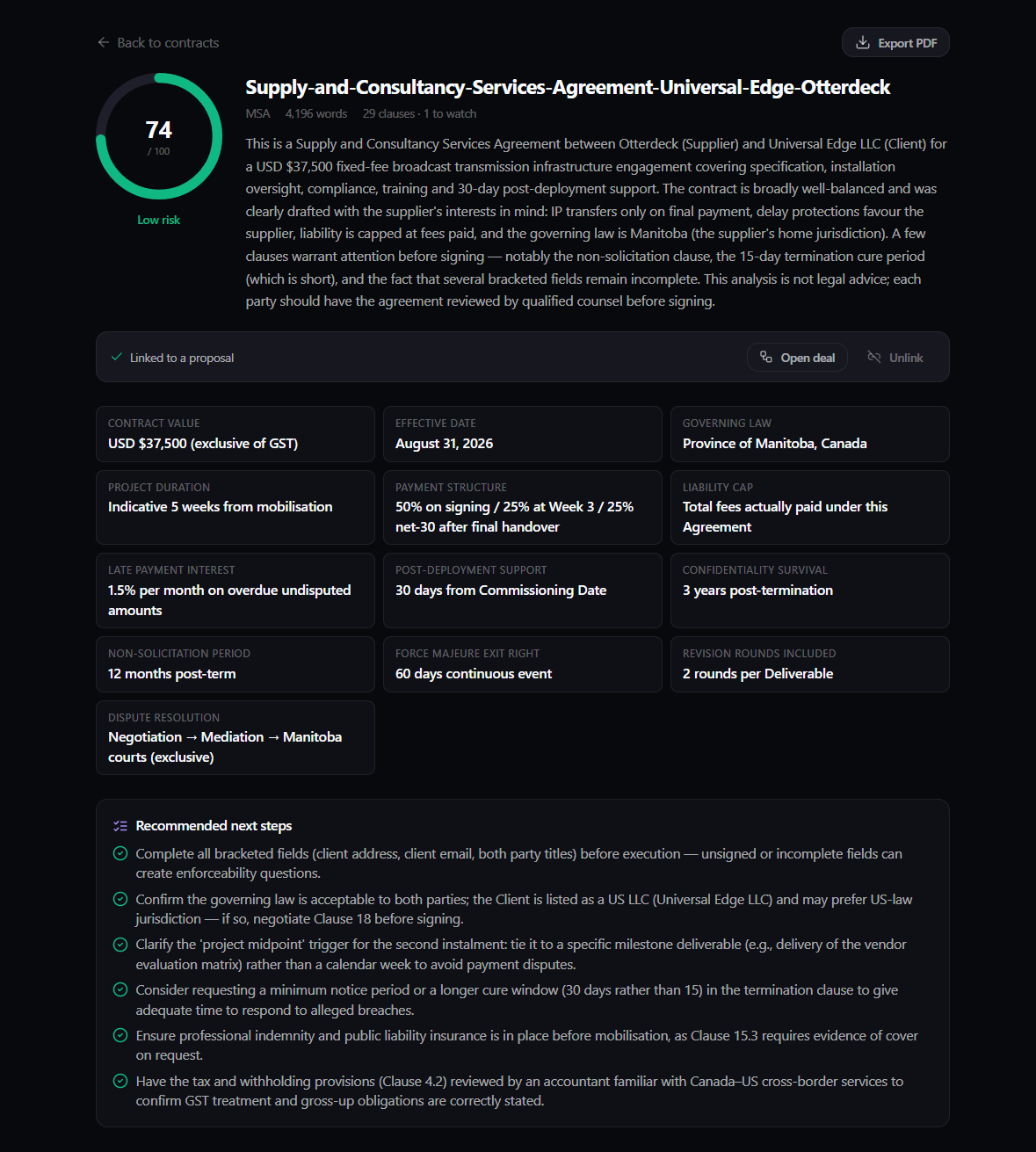
You give it the contract — a PDF or a Word document — and it reads the whole thing the way a careful advisor would. Then it hands back three things.
First, an overall fairness score: how balanced the agreement is toward you, at a glance — a number you can feel in your gut before you read a word.
Second, the risky clauses, ranked — plain English, not legal jargon. What each clause actually means for you, worst first. "This lets them end the contract any time, but you can't. Here's why that matters."
Third, in the full analysis, suggested redlines — plain-language notes on what's worth pushing back on, so you walk in knowing what to ask for instead of just knowing something feels off.
It reads the agreements you actually get sent — NDAs, MSAs, statements of work, vendor and service agreements — and it's fast: a minute or so, not an afternoon.
Every trap it catches, and why it matters
One-sided IP assignment. The clause that hands them everything you make — sometimes including work you did before you met them. Flagged, so you can carve out what's yours.
Uncapped liability. No ceiling on what you could owe if something goes wrong — on a small project, a wildly lopsided bet. You'll see it before you take it.
Slow payment terms. Net-60, net-90 — terms that turn you into their interest-free lender. Flagged so you can ask for something you can live on.
One-sided termination. They can walk away whenever they like; you're locked in. You'll see when the exit only swings one way.
Silent auto-renewal. The clause that renews you for another year unless you cancel in a window nobody remembers. Surfaced, not buried.
Vague scope. Fuzzy wording that invites "quick extra" requests you'll end up doing for free. Named, so you can tighten it first.
Where this fits in the whole deal
Contract review is one stage of Otterdeck, the AI deal desk. From a short brief it writes your proposal, reviews the contract the client sends back, collects the e-signature, and turns the accepted deal into an invoice — all on one timeline, brief to paid.
This is the "read it before you sign it" step. The one that's easy to skip at 11pm when the project starts Monday, and the one that quietly protects your margin. You can see the whole deal desk here.
Try it
Take a contract a client actually sent you and run it through the free checker. You'll get a fairness score and your top risks in about a minute — no account, no credit card. Up to three checks a day.
Check a contract — free, no sign-up →
For the full clause-by-clause breakdown with redline suggestions, a free Otterdeck account includes one full review a month. Pro raises that to ten; Agency is unlimited.
FAQ
Is this legal advice? No — and this is the important one. Otterdeck's contract review is a risk highlighter for information only. It flags the clauses worth questioning so you know what to ask about; it doesn't tell you what's legally enforceable, and Otterdeck isn't a law firm. For anything that matters, have a lawyer make the call. This is the second read before that conversation, not a replacement for it.
Is the checker really free? Yes. The public contract checker needs no sign-up and no credit card — up to three checks a day. You get a fairness score and your top risks. For the full clause-by-clause analysis with redline suggestions, a free Otterdeck account includes one complete review a month.
What kinds of contracts can it read? The ones clients send you: NDAs, MSAs (master service agreements), statements of work, and vendor or service agreements. Upload it as a PDF or a Word document.
What sort of problems does it catch? The traps that quietly cost freelancers money — one-sided IP grabs, uncapped liability, slow payment terms like net-90, one-sided termination, silent auto-renewal, and vague scope that invites unpaid extra work. It explains each in plain English and ranks them by how serious they are.
Does it change or sign the contract for me? No. It reads and flags. You decide what to push back on, and the suggested redlines are plain-language starting points for that conversation — not automatic edits and not legal documents.
How does this connect to the rest of Otterdeck? Contract review is one stage of the deal desk. Otterdeck can write your proposal, review the client's contract, collect the e-signature, and invoice — all on one timeline, from brief to paid. You can start with just the free checker and explore the rest whenever you like.